
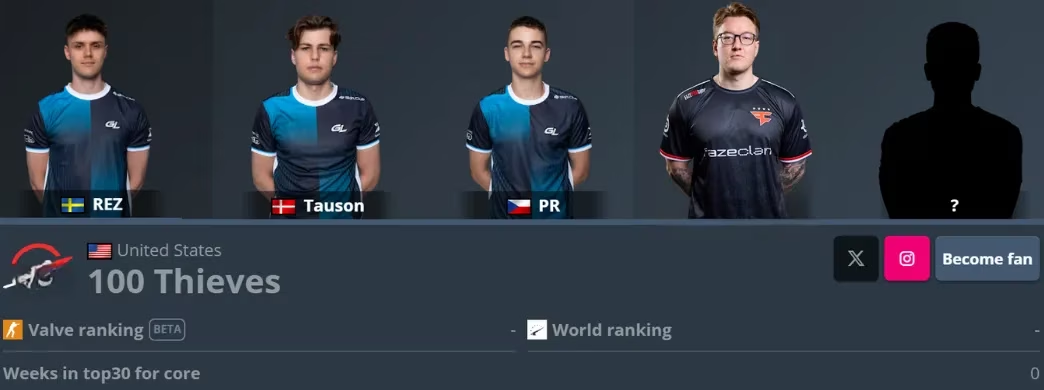
I have been following the North American CS2 scene closely, and the 100 Thieves rebuild is one of the most intriguing stories of 2026. The roster was fully staffed in January, yet the team has not shown up at a single official event. For an organization trying to climb Valve’s regional ranking, that silence felt strange. Graham “Messioso” Pitt later explained that preparation actually stalled for about a week because of a demanding filming schedule for the 100T YouTube channel. Media coverage matters, but can a week of lost practice really be treated as harmless? For a squad that has never played together in official competition, every day matters.
The February Calendar Is Brutal and Revealing
The updated Thieves will finally step into real competition on February 7, when the open qualifiers for IEM Atlanta begin. The path is simple but unforgiving: reach the top four to enter the closed qualification on February 10, where only two slots lead to the main tournament in May. Messioso has taken a philosophical view, describing these matches as a chance to test the waters before full-fledged LAN events. Still, I cannot help asking: is that really a luxury a new roster can afford?
Here is what the immediate schedule looks like from a fan’s perspective:
| Date | Event | What Is at Stake |
|---|---|---|
| February 7 | IEM Atlanta open qualifiers | Top 4 needed to reach closed stage |
| February 10 | IEM Atlanta closed qualifiers | Only 2 slots to the main May event |
| February 19 | Roman Imperium Cup V, Portugal | First offline test, 16 teams, Tier-2 LAN |
| February 24–28 | DraculaN Season 5, Bucharest | Another LAN where early points can be collected |
These opening events are not just warm-ups. In 2026, they are the fastest way for 100 Thieves to prove they belong in the North American elite.
Valve’s Ranking System Does Not Care About Hype
By 2026, the Valve Ranking System, or VRS, has become an uncontested sieve for any team dreaming of a top CS2 division. For 100 Thieves, this is not simply a place in the table. It is a matter of competitive life and death. Their position directly determines whether they receive closed qualification invites or are left grinding through open grids. A strong VRS position is the only reliable key to majors and top events.
The mechanics are rigid. Results are converted into numbers, and those numbers become status. LAN matches are the main focus, forming about 25% of success while producing stable ranking gains. The status of the opponent at the start does not matter much, but winning consistently on LAN creates momentum.
Several nuances define the ranking landscape in 2026:
-
🏆 A “bucket” of wins: Offline victories are pooled into a separate bucket, giving several dozen points per match until a limit is reached.
-
🌐 Network effect: The Opponent Network system analyzes the strength of the teams you beat, while Bounty Collected bonuses reward you for taking down high-value targets.
-
💻 Online grinding: Online qualifications help keep a team on track between major trips, but they weigh significantly less than offline results.
In short, sitting on the hyped 100 Thieves brand is no longer enough. Valve rewards teams that actually work on LAN.
Why These Early LANs Matter So Much
In North America, competition is now based on dry calculation rather than media coverage. For 100 Thieves, it is critically important to cling to several paths:
-
Tier-1 events, where winning matches carries maximum weight.
-
Regional Tier-2 tournaments, which are generally the best way to collect LAN points while bigger teams rest.
-
RMR cycles, where the difference between a direct invite and the open qualifier meat grinder can be measured by only a couple of maps.
This is especially painful for North America because there are few slots. Any team that actively grinds regional finals can quickly surpass more famous but inactive rosters.
From the VRS perspective, the chain of “open → closed → LAN” works like clockwork. Open selections are basically an entrance ticket. They do not give many points directly, but they let a team face rated opponents. Closed stages are more interesting because winning them boosts the Opponent Network. The real voltage starts at the Tier-2 LAN level. Every offline win adds stable weight to the VRS bucket, usually until the top ten matches are filled. If old victories are not replaced by better new ones, progress slows down. That logic is unforgiving, but it makes sense.
A Window That Could Close Quickly
For 100 Thieves, the coming months are probably a window of opportunity that can close. The team simply has no right to miss the opening events. If they do, North American competitors who are not sitting still will quickly create a gap in VRS, and catching up will be extremely difficult.
Early qualifications also offer something valuable: cheap rating gains against strong mid-level opponents. More importantly, entering small LANs early allows a team to secure a position near the top of the regional ranking before the main race for the major begins. A stable top-four or top-six finish in Portugal or Romania would provide exactly the influx of points needed to feel confident. The equation is meaningful: grind now, so you do not suffer later.
The presence of Lucas “gla1ve” Rossander as coach is another powerful element. A four-time Major champion, he now works behind the scenes in CS2. That kind of experience can be decisive when a young or rebuilt roster faces pressure in early qualifiers. But can even gla1ve’s leadership compensate for lost practice time and a delayed debut?
Outside CS2, 100 Thieves has also made a curious move in Apex Legends by teaming up with Crazy Raccoon under the “Crazy Thieves” tag for ALGS Year 5. It highlights the brand’s global ambitions, but my focus remains on Counter-Strike. A strong global brand does not automatically translate into VRS points.
Will 100 Thieves seize this early grind, or will the delayed start cost them in a system that punishes inactivity? The first real answer arrives on February 7, and after that, there will be very little room for excuses.
Comments