
In the ever-shifting world of Counter-Strike 2, few stories capture the grind of international team-building quite like Alexandre “bodyy” Pianaro’s early months as Fnatic’s in-game leader. Back in 2024, on the verge of ESL Pro League Season 19, the French captain opened up about the challenge of calling in English, the weight of Fnatic’s legacy, and the steep hill his squad faced in one of the most stacked groups of the tournament. Now, in 2026, with the CS2 landscape continuing to evolve, those reflections still serve as a raw look at what it takes to turn a new roster into a contender.
A New Captain, A New Language
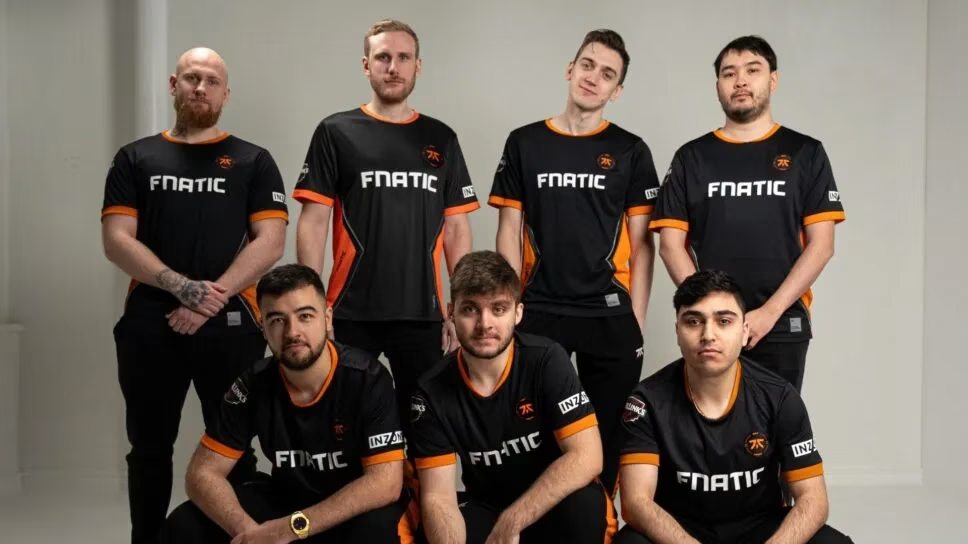
Bodyy took the reins of Fnatic in November 2023, stepping into a role that demanded more than just crisp aim and sharp game sense. The organization had fully embraced an international project, and for a French player who had spent most of his career in Francophone lineups, the transition was no walk in the park.
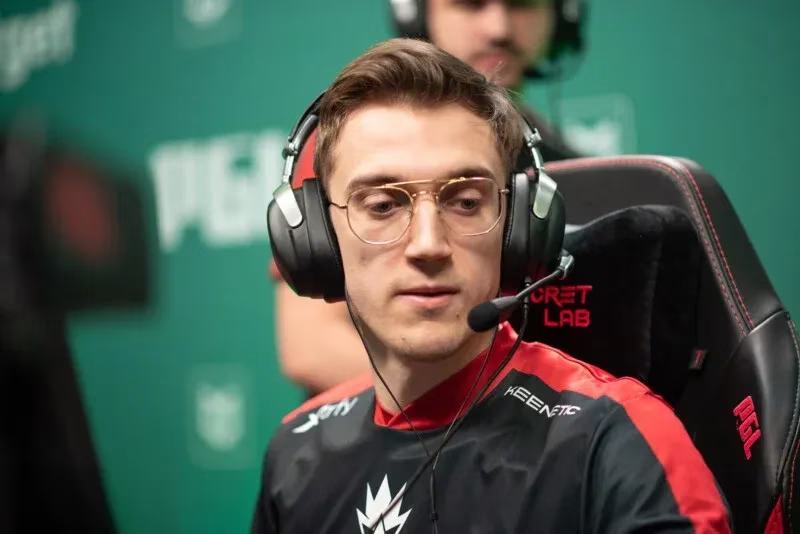
“My first experience in English was in Falcons when we added BOROS, lauNx, and mhL to the team,” bodyy recalled. “I’ve had some time to talk and learn [how] to express myself in English. Obviously, it wasn’t the best environment to grow and to build up, so I wouldn’t say that was such a big experience and not a long time as well. When I joined ITB as [a] stand-in — new people, new culture, it’s not easy to create something in that short time.”
His real baptism by fire came when Fnatic came calling. For the first time, bodyy had to call in English, articulate his ideas, explain his background, and share his vision of the game with players and coaches from different countries. The challenge was not just vocabulary; it was about making sure everyone spoke the same Counter-Strike language.
Building from the Ground Up
Fnatic fans have witnessed the organization lift trophies in Counter-Strike, but recent years have painted a different picture. In his first six months as captain, bodyy came to believe that the team needed more time — especially after missing out on the first CS2 Major.
“This team was built six months ago,” he said. “Our expectations were to qualify for the Major, which we didn’t. I can’t say this satisfied me or anyone in the team. This team was new, time was needed to build a culture and a structure for this team. We have youngsters, some of us have never played in international teams, so we have to put all the pieces together.”
According to bodyy, outsiders often underestimate how difficult it is to build a new team from scratch. Time is a luxury that competitive Counter-Strike rarely affords, but it remains essential. “I think people don’t realize it’s always hard to build a new team and time is obviously needed,” he added. “We are coming to this tournament to prove that all the past months were of hard work.”
The KRIMZ Constant
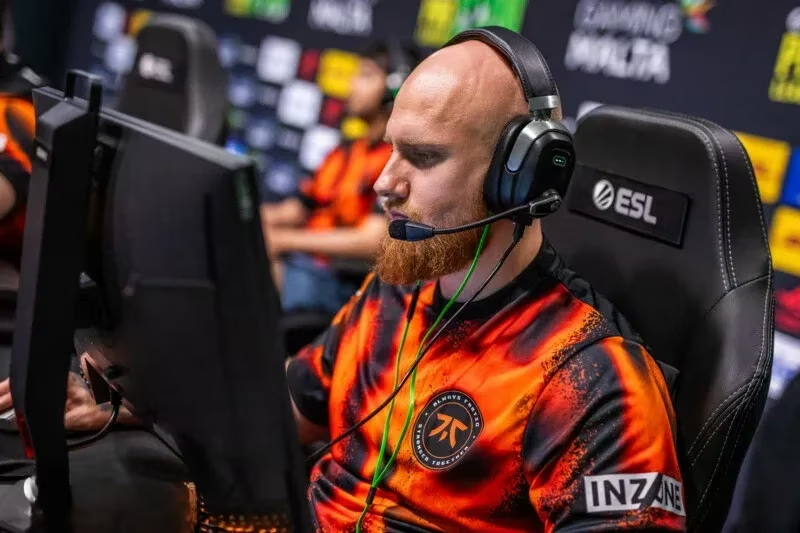
While players come and go, one name has remained a fixture on Fnatic’s active roster since 2016: KRIMZ. His longevity offers a rare thread of continuity through the organization’s international rebuild. For bodyy, having a veteran of KRIMZ’s caliber alongside a mix of youngsters and international newcomers is both a blessing and a reminder of the standards that Fnatic expects.
The Hardest Group in the Tournament
When ESL Pro League Season 19 rolled around, bodyy did not mince words about the challenge ahead. In his eyes, Fnatic had landed in the most stacked and toughest group of the competition. Even with SAW replacing Cloud9, he had no doubts about the group’s firepower.
“I reckon that we have the hardest group stage of the tournament, I think. In my opinion, we have the most stacked group,” bodyy said. “SAW replaced Cloud9. Probably the group was even more stacked before, but SAW is a really strong team and they have been beating us. I’m sure they can do damage in this group.”
For Fnatic, the goal was clear: reach the playoffs. But bodyy knew that a deep run would require a statement performance on LAN — a big reference match that could validate months of hard graft.
“My goal is to go to playoffs, but we definitely need a big result in LAN and a big reference match that maybe we had [online]. But that’s not our goal and not Fnatic’s expectations, [either]. We want to get a big match [in] the bag and make it to playoffs. It’s definitely doable. Our preparation has been great. Beating Virtus.pro, [which] is one of [the] hardest teams that we have been facing recently, would be a relief to us. Now that they have electroNic, they will be even better.”
What It Means in 2026
Two years on, the CS2 scene has continued to shift. Rosters have changed, new stars have emerged, and the margin between victory and defeat remains razor-thin. Yet bodyy’s early Fnatic experience still offers a valuable lesson: international success is not built overnight. It takes patience, clear communication, and the willingness to grind through growing pains.
For Fnatic, the journey was never going to be a cakewalk. But with bodyy at the helm, the team was determined to put in the hard yards and prove that the quiet months of work would eventually pay off. Whether that meant a playoff run at ESL Pro League Season 19 or a statement win over a team like Virtus.pro, the mission was simple: turn potential into results.
| Key Takeaway | Bodyy’s Perspective |
|---|---|
| Calling in English | First real test came with Fnatic; required sharing game vision clearly |
| Team-building | New roster needed time to create culture and structure |
| Major miss | Missing the first CS2 Major was a disappointment, not a satisfaction |
| EPL group | Called it the hardest and most stacked group |
| Goal | Make playoffs and secure a big LAN reference win |
Stay tuned to esports.gg for the latest CS2 news and updates.
Comments