
The screen hums softly in the dim glow of my room, its colors bleeding into the quiet night like memories I can’t quite shake. I see the familiar covers of Grand Theft Auto and Counter-Strike — that sun-bleached palette of vice, the stark silhouette of a counter-terrorist — and for a moment, I am sixteen again, palms sweaty on a borrowed keyboard in an internet cafe in Dushanbe. That place is gone now, shuttered by the same decree that branded these pixels as poison.
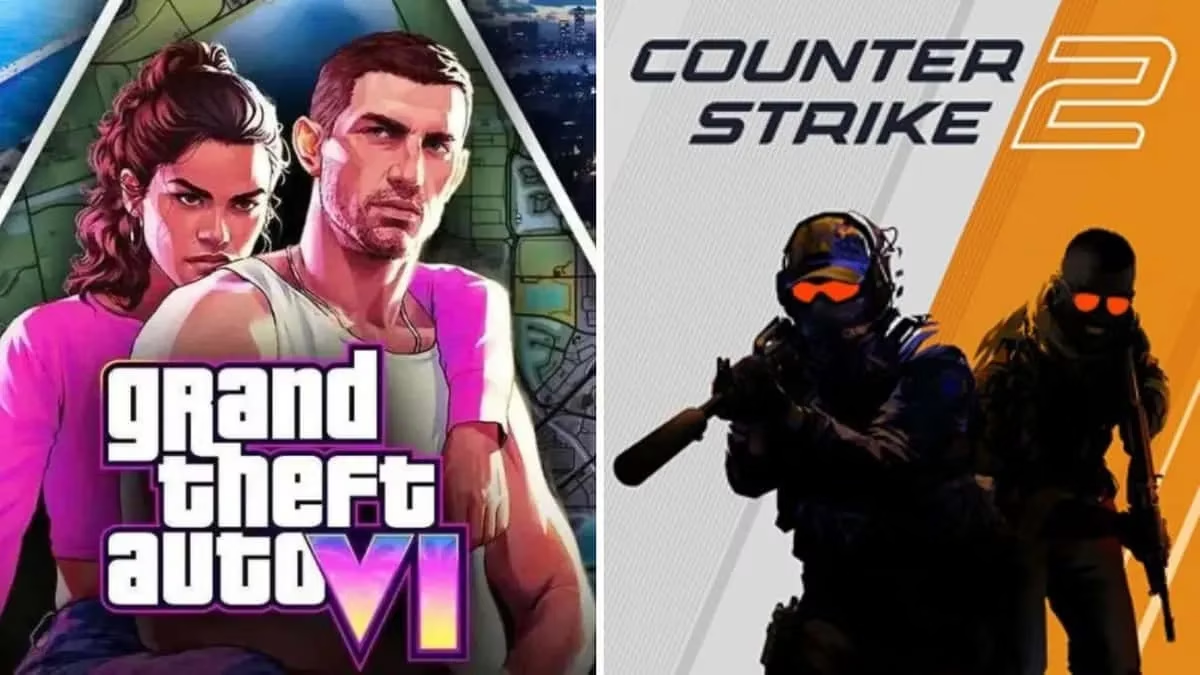
It’s been two years since Tajikistan drew its line in the virtual sand, painting these games as sirens luring youth into “various crimes.” The interior ministry’s words still echo in news archives: “Young people and teenagers who regularly play these games come under their negative influence…” I remember reading that and feeling a strange twinge, a flicker of guilt wrapped in disbelief. I had spent countless hours defusing pixelated bombs, sprinting through dust2, hijacking digital cars because the narrative asked me to. Did any of that seep into my soul? I never stole a real car. I never fired a real gun. But the fear in those headlines felt genuine, a parental anxiety turned into law.
Yet, year after year, the world tightens its grip on our digital playgrounds. This pattern isn’t new, but it’s become a drumbeat. In August 2024 — the same year Tajikistan raised its walls — Turkey blocked access to Roblox, that infinite sandbox of blocky dreams. The reason struck closer to the bone: child exploitation, grooming, financial coercion. Predators hiding inside adorable avatars. I saw the hashtag #FreeRoblox flood my feeds, Turkish children marching with handmade signs, their faces a mix of confusion and defiance. They weren’t defending virtual bloodshed; they were defending their friendships, their creative spaces, their right to build worlds together. That ban felt different — less about immoral content, more about a failure to protect the innocent inside a compromised system.
October 2024 brought another tremor: Kuwait refused to approve Call of Duty: Black Ops 6. Activision quietly refunded pre-orders, and the silence that followed was deafening. No clear reason was ever given, just a bureaucratic void. It made me wonder — what phantom triggered that rejection? A mission set in the Middle East, a sensitive historical echo, a political reading of digital warfare? The opacity felt like a curtain falling over a stage where I once danced with shadows.
Now, in 2026, these moments have woven themselves into a global tapestry of digital censorship. I scroll through forums where players from different latitudes swap tales of region-locked launchers and VPN pilgrimages. The games haven’t disappeared; they’ve simply become contraband, their allure magnified by prohibition. Some studies released in 2025 argued that violent games do not create violent people — they are mirrors, not molds, reflecting our inner struggles without shaping them. Other reports, equally passionate, pointed to screen addiction, to a generation losing its grip on real-world empathy. Truth, as always, is a glitch between pixels.
I think of the missions I once ran in GTA. Yes, I committed heists, I crashed helicopters, I navigated a morally gray underworld. But I also remember the satirical radio stations, the hauntingly beautiful sunsets over Los Santos, the quiet moments riding a bike through the hills with a friend. The game wasn’t a manual for crime; it was a chaotic symphony of American excess, a mirror held up to a society we journalists often critique. And Counter-Strike? That was pure sport — a ballet of reflexes and strategy, teamwork as crisp as a winter morning. Calling it a “terrorism simulator” always felt like reducing chess to a game about assassination.
And yet, I can’t fully dismiss the fear. I’ve seen teens lose themselves in screens, their eyes glazed, their laughter replaced by grunts of frustration. I’ve watched a cousin obsess over kill-death ratios until his grades crumbled. The games aren’t evil, but they are powerful. Power without context can be dangerous, especially for minds still learning to separate the rush of a headshot from the gravity of real pain. The Tajikistan ban, in its bluntness, acknowledged that power. It just chose to destroy the mirror, not to teach people how to gaze into it.
Let me paint you a table of these recent digital exiles, a timeline of pixels turned pariah:
| Year | Country | Game(s) | Stated/Assumed Concern |
|---|---|---|---|
| 2024 | Tajikistan | GTA, Counter-Strike | Violent and immoral content leading to crimes |
| 2024 | Turkey | Roblox | Child exploitation and grooming |
| 2024 | Kuwait | Call of Duty: Black Ops 6 | Undisclosed (likely political/cultural sensitivity) |
| 2025 | (Speculative whispers) | Several battle royale games | Government monitoring of “digital aggression” |
Each row is a story of a society trying to protect its children from something it doesn’t fully understand. As a player, I feel caught in a crossfire — between my love for these intricate worlds and the uneasy knowledge that they can, in rare cases, be used as ammunition for real-world harm. The bans often overlook the community: the modders, the artists, the storytellers who take the raw engine and craft narratives of hope, of protest, of love. In Roblox, kids were learning to code, to design, to handle virtual economies. The predators were the invaders, not the game itself. Yet the ban came down like a sledgehammer, smashing both parasite and host.
I find myself walking a tightrope in my own heart. When I boot up a game tonight — perhaps a freshly patched, uncensored title that slipped through the cracks — I’ll do so with a different kind of awareness. I’ll hear the Tajik minister’s plea to parents, echoing across time: “Monitor your children’s activities.” Not ban, but monitor. Not fear, but presence. That phrase lingers like a note of grace in a hardline symphony. Perhaps the answer isn’t the delete key, but the dialogue that happens after we press pause.
The sun is rising outside my window, painting gold over my keyboard. The pixels fade, but the questions remain, as persistent as the hum of a distant server farm storing memories of deeds both cruel and kind. I am a player, and this is my lament — not for the games, but for the conversations we never had. ⏸️",
"thumbnail": "https://www.dexerto.com/cdn-image/wp-content/uploads/2024/11/03/GTA-and-Counter-Strike.jpg?width=1200&quality=60&format=auto
Comments