
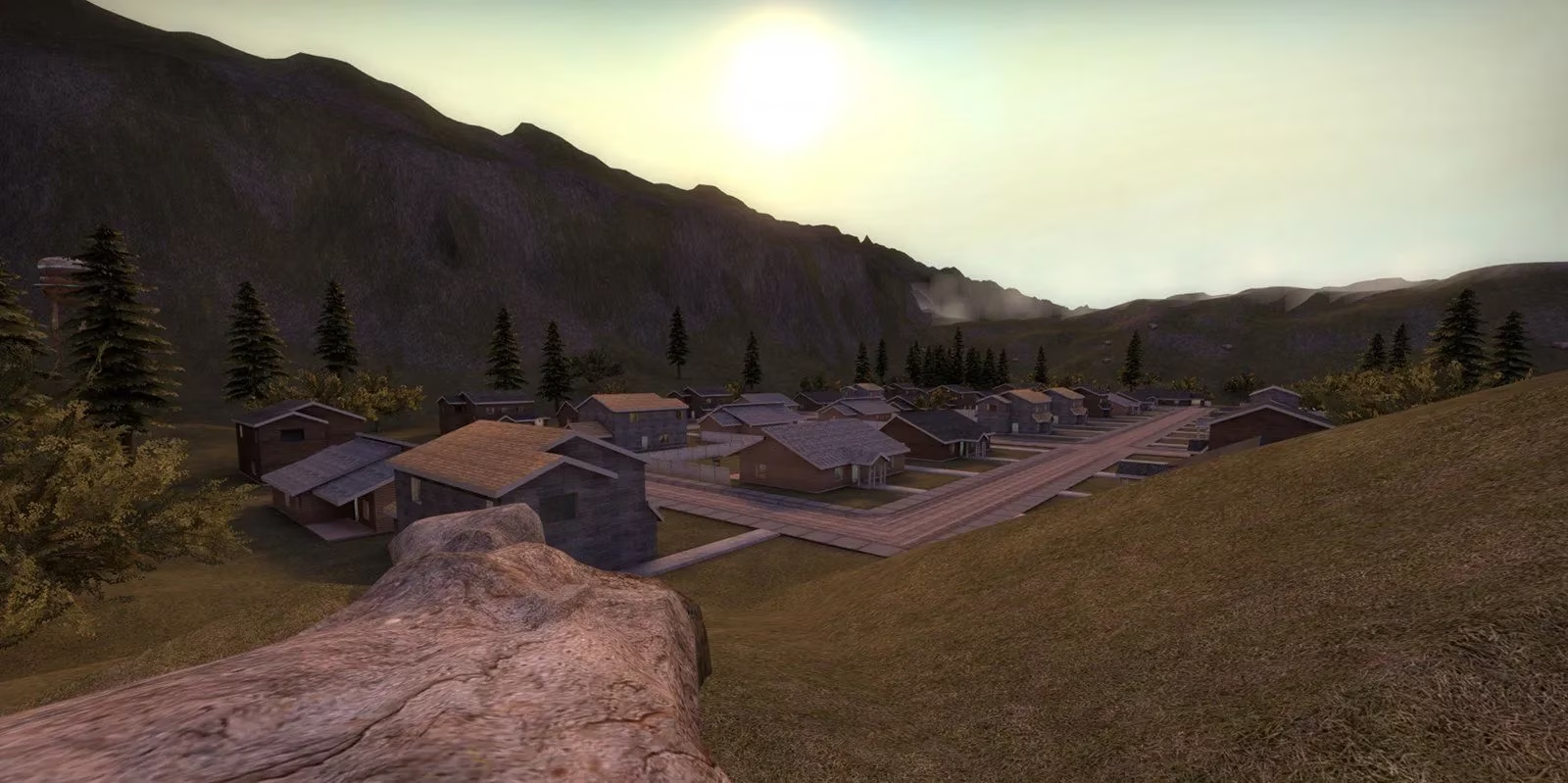
I remember the first time I parachuted into the desolate, sprawling expanse of what felt like a forgotten military training ground. It was 2026, and while the gaming world had long moved on to the latest photorealistic battle royale titles, I found myself drawn back to a relic—a mod born from a simple 'what if?' for Counter-Strike: Global Offensive. This wasn't just another custom map; this was Go 4 The Kill (Go4TK), a battle royale experiment that felt like discovering a ghost town built within the skeleton of a game I thought I knew inside out. The silence before the storm was profound, broken only by the rustle of my own gear and the distant, echoing footsteps of 48 other souls scattered across a landscape four times the size of Overpass.
🛠️ The Mod's Unique Blueprint
What made Go4TK so fascinating was its brutal, stripped-down philosophy. Kinsi, the modder, didn't try to replicate the complex systems of modern BRs. Instead, they built upon CS:GO's core in clever, sometimes jarring ways. The map was vast, yet it ran as smoothly as Dust II because it was all essential geometry—a chessboard of concrete blocks and barren hills where every piece of cover felt deliberately placed, like teeth in a comb. Performance was king, and the design reflected that.
The weapon handling was where the mod truly carved its own identity. Gone were the meticulous spray patterns I had spent thousands of hours mastering. In their place was a system of randomized inaccuracy but zero recoil patterns. It created a surreal, high-stakes shooting experience. Aiming down sights felt like trying to draw a straight line with a compass that had a wobbly leg—unpredictable yet strangely fair. Every shot was a gamble, making engagements less about pure muscle memory and more about positioning and opportunistic bursts. Furthermore, running and gunning was not just viable; it was encouraged, as sprinting never penalized your firing accuracy. This turned firefights into frantic, mobile dances across the open terrain.
🎮 Features That Felt Ahead of Their Time (And Some That Didn't)
Go4TK packed features that, looking back, feel prescient for a community mod:
-
49-Player Mayhem: Squeezing nearly 50 players into a CS:GO server was a technical feat in itself, creating a density of conflict that was rare for the engine.
-
Custom Gun Playground: The ability to tweak firearm characteristics was a sandbox lover's dream. I spent hours creating the perfect, personalized rifle, a process that felt like tuning a radio to a frequency only I could hear.
-
Competitive Leaderboards: The mod baked in leaderboards, fueling that innate CS desire for bragging rights. Climbing the ranks in this niche mode felt like earning stripes in a secret society.
💀 The Rise, Fall, and Flicker of Hope
My journey with Go4TK was bittersweet. I joined late, in late 2025, just as its original lifespan was ending. The mod had launched years prior but, like a satellite with a decaying orbit, it eventually lost traction, particularly in North America. The servers went dark due to 'lack of interest,' a phrase that haunts many passionate mod projects. For a while, it was just a memory—a set of files on my hard drive pointing to nowhere.
But the story didn't end there. The CS community, in its vast and generous network, has a way of preserving these artifacts. Thanks to the intervention of what was once described as a 'generous Redditor,' there have been sporadic efforts to resurrect the servers. In 2026, I've managed to find these revived pockets. The player count isn't what it was, but on certain weekends, a few dozen of us—the curious, the nostalgic, the explorers—log back in. The experience now is like walking through an interactive museum exhibit; the systems are all there, functional, waiting for players to bring them to life again, if only for a few matches.
🤔 Reflections on a Digital Fossil
Playing Go4TK today is a strange time capsule. Counter-Strike: Global Offensive itself has evolved, but this mod exists in its own amber. It's a testament to the creativity of the modding scene, proving that even the most established games can be reimagined in radical ways. It wasn't a polished product, but it was a bold experiment. Its legacy isn't in a persistent player base, but in the idea it represented: that the DNA of a tactical shooter could be spliced with the last-man-standing chaos of battle royale, resulting in something uniquely clunky and compelling.
For those who remember it, Go 4 The Kill remains a fascinating 'what if' chapter in CS:GO's long history—a ghost mode, waiting in the shadows for its next moment in the sun.
Comments