
As I reflect on the incident involving Brazilian CS:GO player Fer and his recent Twitch stream controversy, I can't help but think about how deeply racism is embedded in societies worldwide. We often hear about racial issues in the United States, but this situation reminds me that Brazil faces equally troubling problems. When Fer made comments about "good" versus "bad" hair during his live stream, he wasn't just being offensive—he was tapping into Brazil's specific racial hierarchy that many outsiders don't fully understand. How can we, as a global gaming community, address these deep-seated prejudices when they manifest in our virtual spaces?
Understanding Brazil's Unique Racial Context
What makes Brazil's racial dynamics so complex? Unlike the United States, where racism often centers on skin color, Brazil has developed a more nuanced—and in many ways, more insidious—system of discrimination. Having lived through 2026 and observed ongoing global conversations about race, I've come to understand that Brazilian racism frequently focuses on phenotypic characteristics associated with African ancestry. The texture of one's hair, the shape of facial features, and other physical traits become markers of social status. Fer's comments about hair being "smooth" versus "hard and bad" directly reference this cultural framework where straight hair is valued over Afro-textured hair. Isn't it troubling how these beauty standards perpetuate racial hierarchies?
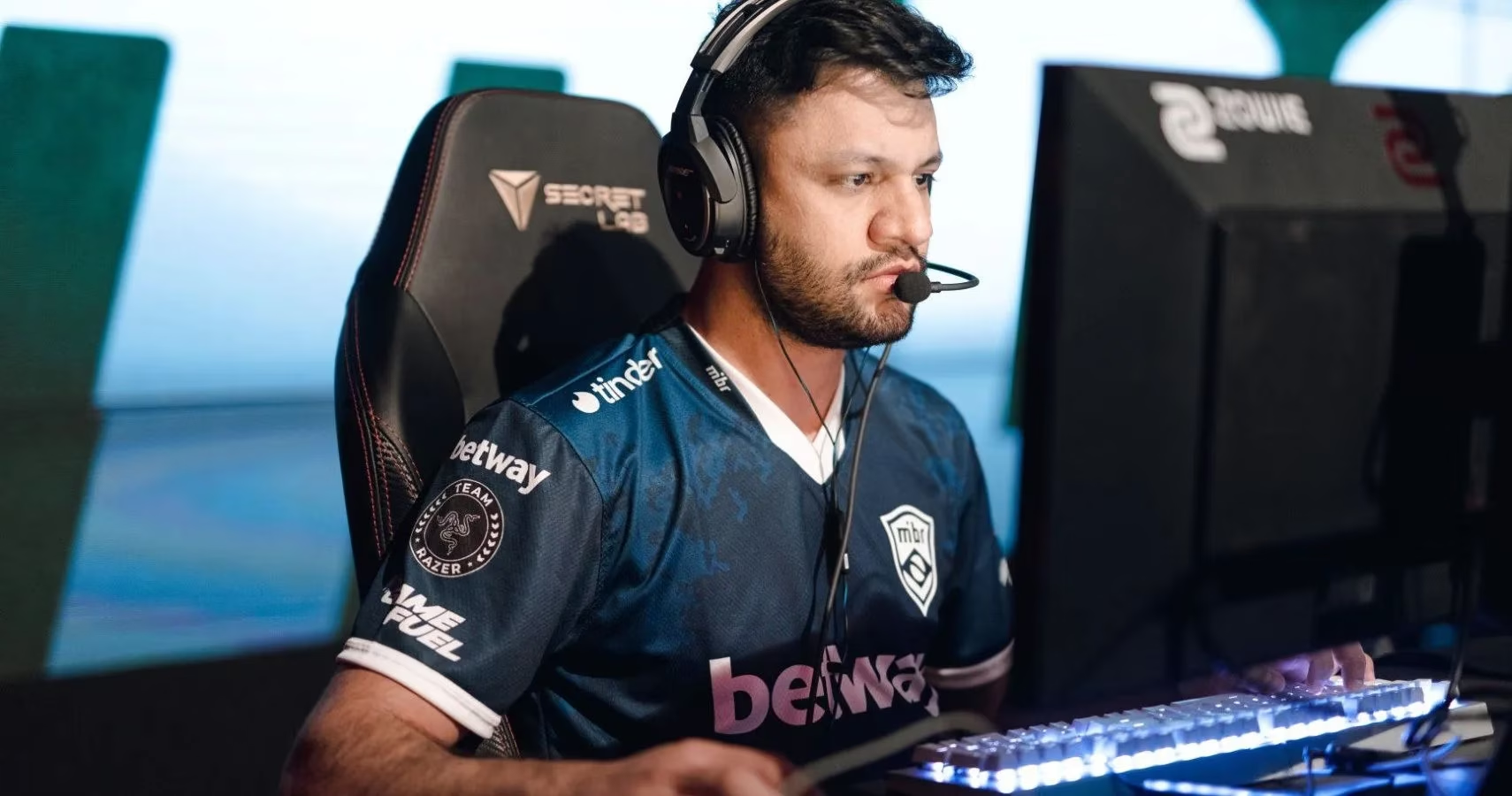
When Fer responded to a viewer's comment about his hair-flipping habit, he didn't just defend his mannerism—he weaponized racial stereotypes. His statement, "Are you sad because your hair is hard and bad? My hair is good, it is quite smooth," reveals how normalized these prejudiced attitudes have become. As someone who follows esports closely, I've noticed that professional gamers often operate in bubbles where they feel insulated from real-world consequences. But in 2026, with increased scrutiny on streaming platforms, such behavior can't be ignored.
The Incident and Its Aftermath
The sequence of events following Fer's comments tells us much about accountability in the esports world:
-
The Live Stream Incident - Fer makes racially charged comments about hair texture
-
Initial Reaction - Chat participants immediately call out the racism
-
Defensive Escalation - Fer responds with offensive gestures and vulgar language
-
Delayed Response - Days pass without acknowledgment or apology
-
Organizational Action - MIBR finally issues condemnation and imposes a fine
What strikes me most is the gap between the incident and Fer's eventual apology. In today's connected world, where social justice movements have gained unprecedented momentum, this delay suggests either a lack of understanding about the severity of his words or a hope that the controversy would simply fade away. MIBR's decision to fine Fer represents progress, but I wonder if financial penalties alone can address the underlying attitudes.
Brazil's Broader Racial Justice Struggle
To fully grasp why Fer's comments generated such outrage, we need to consider Brazil's current social climate. Even in 2026, Brazil continues to grapple with:
-
Police brutality disproportionately affecting Black citizens
-
Economic disparities along racial lines
-
Representation gaps in media, politics, and professional spaces like esports
-
Cultural norms that privilege European features and characteristics
During the 2020s, Brazil saw its own powerful demonstrations against racial injustice, parallel to the Black Lives Matter movement in the United States. These protests highlighted how systemic racism manifests in Brazilian institutions. When public figures like Fer make casually racist remarks, they're not just expressing personal opinions—they're reinforcing systems that marginalize millions of people.
The Esports Community's Responsibility
As someone who participates in gaming communities, I've been thinking about what this incident means for esports as a whole. Professional gaming has grown into a global industry with massive cultural influence. With that influence comes responsibility. Here's what organizations and players should consider moving forward:
| Area for Improvement | Specific Actions | Expected Outcome |
|---|---|---|
| Cultural Education | Mandatory workshops on racial sensitivity | Players understand local and global racial contexts |
| Accountability Systems | Clear protocols for addressing discriminatory behavior | Consistent responses to incidents |
| Community Standards | Enforced codes of conduct for streams and competitions | Safer, more inclusive environments |
| Diverse Representation | Active recruitment of diverse talent at all levels | Broader perspectives in decision-making |
Why should esports organizations care about these issues? Beyond the moral imperative, there are practical considerations. Diverse, inclusive communities are more innovative and sustainable. They attract broader audiences and create environments where all players can thrive. When incidents like Fer's racist tirade occur, they damage not just individual reputations but the credibility of entire organizations and the industry itself.
Personal Reflections on Language and Power
Fer's use of the middle finger and crude suggestion that viewers insert objects into their rectums reveals another dimension of this incident: the abuse of power dynamics between streamers and their audiences. As a streamer with thousands of followers, Fer holds significant influence. His responses to criticism—whether about gameplay or personal conduct—carry weight. When he responds to accusations of racism with further aggression and vulgarity, he's essentially telling his community that their concerns don't merit respectful engagement.
This makes me wonder: How many other streamers and professional gamers harbor similar attitudes but haven't been caught on camera? The gaming world has made progress in addressing overt sexism and homophobia, but racism often operates through more subtle cultural codes—like comments about hair texture or facial features. These microaggressions can be just as harmful as more blatant forms of discrimination.
Moving Forward: Lessons Learned
Looking back on this incident from the perspective of 2026, several lessons emerge for the gaming community:
🔥 Immediate accountability matters - The delay in Fer's apology allowed the situation to escalate
🔥 Education must precede competition - Players need cultural understanding before they represent organizations
🔥 Fines alone are insufficient - Lasting change requires ongoing education and community engagement
🔥 Global awareness is crucial - What might seem harmless in one cultural context can be deeply offensive in another
As I write this, I'm reminded that progress isn't linear. While we've seen improvements in how esports organizations handle discrimination cases since 2020, incidents like Fer's racist comments show how much work remains. The fact that he felt comfortable making such remarks on a public stream suggests that either he didn't recognize their racist nature or didn't fear meaningful consequences.
Conclusion: A Call for Conscious Gaming Communities
The Fer incident serves as a reminder that racism adapts to different cultural contexts. In Brazil, it might focus on hair texture; elsewhere, it might emphasize skin tone or facial features. But the underlying harm—the dehumanization of people based on perceived racial characteristics—remains the same. As gaming continues to grow as a global phenomenon, we must develop the cultural literacy to recognize and challenge racism in all its forms.
What kind of gaming community do we want to build? One where players like Fer can make racially charged comments with minimal consequences? Or one that actively promotes respect, understanding, and inclusion across all cultural boundaries? The answer seems obvious, but achieving it requires continuous effort from players, organizations, and fans alike. Only through this collective commitment can we create virtual spaces where everyone can compete and connect without fear of discrimination based on who they are or how they look.
Comments