
In the ever-evolving landscape of professional Counter-Strike: Global Offensive, stability is often as crucial as raw skill. Yet, for the former OpTic Gaming roster, that foundation crumbled in late 2019, leading to the official dissolution of the team. The core issue stemmed from the sale of parent company Infinite Esports to Immortals Gaming Club (IGC) earlier that year. This acquisition created an immediate conflict of interest, as IGC already owned the prominent Brazilian squad MIBR. To comply with league rules, the OpTic CS:GO team had to be released, leaving the players in a state of limbo, searching for a new organizational home while rumors swirled about potential suitors. But what does the future hold for these talented individuals now, several years removed from this pivotal moment?
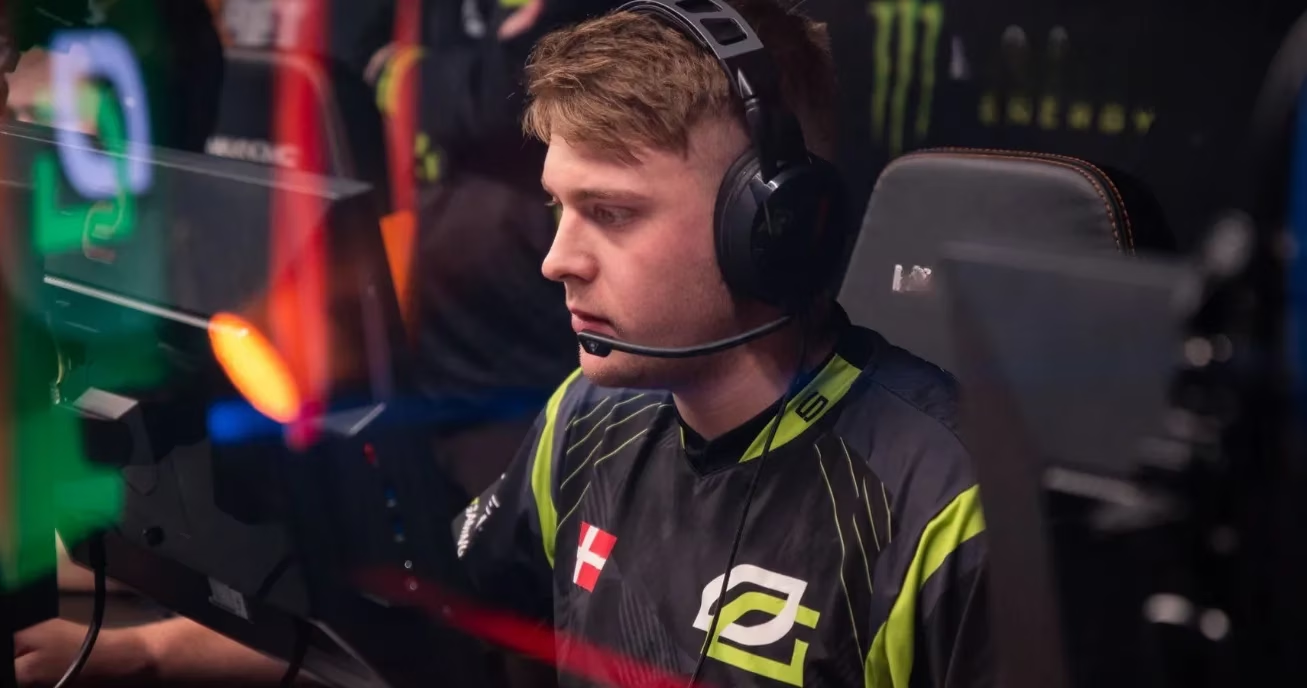
The unraveling began with a key departure. North, a Danish organization, swooped in to acquire seasoned player René "cajunb" Borg. This move reduced the OpTic lineup to four, putting immense pressure on the remaining core. Shortly after, the team's in-game leader, Mathias "MSL" Lauridsen, made a significant announcement on social media. He revealed he was benching himself from the active roster. In his statement, MSL pointed directly to the sale of OpTic as a major setback, crippling the team's competitive ambitions. He detailed plans to strengthen the squad by purchasing established players—a common strategy for climbing the ranks—but cited the organization's instability as the fatal barrier. "OpTic wouldn't let us buy any players," was a sentiment later echoed by his teammates. MSL, a veteran leader primarily experienced in Danish teams aside from a brief stint with North America's Rogue, declared himself open to new opportunities across both Europe and North America.
The final nail in the coffin came from star rifler Kristian "k0nfig" Wienecke. His announcement was blunt: the team had chosen to disband because "there is no future." Like MSL, k0nfig stated he was "ready to be sold individually," highlighting the shift from a team unit to a group of free agents. He provided further insight into the frustrating stagnation, calling the entire period a "waiting game" where the organization's paralysis prevented any meaningful progress. Despite the disappointing outcome, k0nfig expressed fondness for his time playing with MSL and teammate Nikolaj "niko" Kristensen.
In its final days, the OpTic roster was filled with promising but unproven talent, a clear sign of an organization unable to invest. This included 18-year-old René "TeSeS" Madsen and 19-year-old Oliver "kwezz" Rasmussen, who had joined as a stand-in less than a week prior to the disbandment. Both young players took to social media to express their availability for European offers, hoping to jumpstart their careers elsewhere.
The team's last competitive outing was a dismal showing at ESL Pro League Season 10, where they finished at the bottom of their group after losses to powerhouses like FaZe Clan, mousesports, and BIG. This poor result underscored the roster's unresolved issues and lack of direction. Following the breakup, the contractual situation was clear: all players remained under contract with OpTic Gaming. This meant any organization interested in acquiring them would need to negotiate a buyout, adding another layer of complexity to their career transitions.
Looking back from 2026, the disbandment of OpTic's CS:GO roster serves as a classic case study in how organizational upheaval can derail a team's potential. The players, once united under a common banner, were scattered to the winds, forced to navigate their careers amid uncertainty. Their journey raises important questions: How many promising rosters have been lost to corporate mergers and conflicts of interest? And what safeguards exist for players caught in the middle of such transitions? The legacy of this OpTic squad is a cautionary tale about the fragile ecosystem of esports, where talent alone is not always enough to guarantee survival.
Comments