
I still remember the first time I held the AWP Chrome Cannon in my hands—its metallic sheen catching the cold light of Dust II, every inch of it whispering untold wealth. I had never owned a skin worth more than a few dollars, but for one glorious week in the spring of 2024, fate gifted me a treasure I could never afford. That was the week Valve turned the Counter-Strike 2 economy upside down with a single, poetic gesture: the Kilowatt case rental.
Back in May 2024, when the world was still learning to love CS2’s rebuilt smoke grenades and refined gunplay, a quiet revolution arrived. On the 23rd of that month, alongside the M4A4’s price drop to $2900, the long-awaited visual distinction between Molotovs and incendiary grenades, and a massive rework of Vertigo’s A site, a new button appeared inside the Kilowatt case opening screen. It said, simply, “Open to rent.”
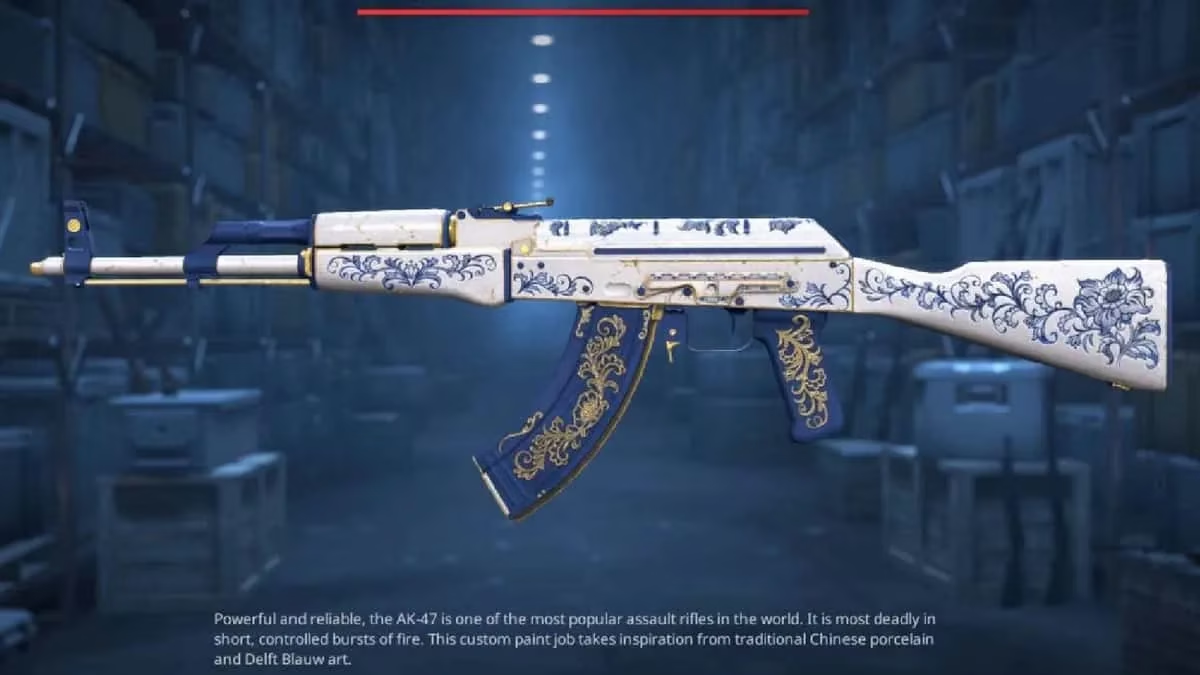
I was skeptical at first. Renting digital weapon skins? The concept felt almost too generous for Valve, the same company whose marketplace had spawned a multi-billion-dollar skin economy. Yet there it was: for the price of a single case and key—roughly $3.50 in total—I could borrow every single non-knife skin from the Kilowatt collection for seven days. All seventeen of them. The AK-47 | Inheritance, the AWP | Chrome Cannon, the M4A1-S | Blue Phosphor, all those impossible dreams I’d only admired in kill feeds and inventory screenshots, suddenly mine to wield.
There were, of course, constraints woven into this temporary privilege. The rented skins couldn’t be customized with stickers or nametags; they refused to show any personal touch. They couldn’t be traded or sold on the marketplace, sealing them off from the economy entirely. And when the clock struck zero on the seventh midnight, the paint would silently strip away, leaving behind the default factory metal. But those seven days? They were a festival.
The ritual itself was simple. You clicked “Open Kilowatt Case,” and two options appeared like two diverging paths: “Open to keep,” which gave you a permanent single skin as in the old days, and “Open to rent,” the gateway to a week-long masquerade. Choosing rent felt like signing a pact with a fairy godmother—your ordinary loadout transformed into a showcase of chromatic elegance. I remember the quickened heartbeat as I saw the AK-47 Inheritance materialize in my hands on the first round of a competitive match. Its golden engravings seemed to challenge the opponents, daring them to underestimate a player who looked this wealthy.
But beauty here was borrowed, not owned. That truth shaped every moment. I walked onto Dust II with the swagger of a high roller, yet deep inside, a whisper reminded me that the illusion would end. It was this very tension that made the experience electric: the knowledge that each headshot with the Chrome Cannon, each spray transfer with the Purple DDPAT, was a fleeting celebration of impermanence. In a game where hundreds of dollars can be locked into a single virtual item, renting inverted the psychology of possession. It asked, “What if the pleasure is in the using, not the having?”
Two years have passed since that May evening, and the rental system remains a curious footnote in CS2’s evolution. The Kilowatt case still stands alone, the only one offering this fleeting privilege. No other case has been granted the same feature, and the knife skins continue to elude the hands of renters, forever barricaded behind the gates of true ownership. Perhaps Valve saw it as an experiment, a single flower blooming in an otherwise cold marketplace. Yet for those who tasted it, the memory persists like a half-remembered dream.
I often return to that week in my mind. I had been on a losing streak—doubtful, timid, afraid to take the first peek mid on T side. Then the rented skins arrived, and with them a strange confidence. It felt as if the cosmos had handed me a gilded mask, allowing me to act the part of a seasoned veteran. My teammates treated me differently; enemies hesitated before engaging. The power of perception, I learned, is as real in virtual warfare as it is in life. For seven days, I was a prince in borrowed robes, and the realm of Counter-Strike was my kingdom.
✨ The allure of the rental system was never just economic; it was emotional. It democratized beauty, even if only for a blink. It let a struggling student touch the same gold that previously belonged only to traders and whales. And in that generous act, CS2 reminded us that every skin, no matter how rare, is just a coat of digital paint—its true value lies not in its market price but in the stories it helps us tell.
As I write this in 2026, the servers are still alive with the echoes of the Kilowatt rental. Some newcomers ask me about the Chrome Cannon I can no longer equip, and I smile, recounting the tale. The skins are gone, returned to the ethereal vault from which they came, but the memory of holding them remains vivid. In a world obsessed with permanence and accumulation, that week of rented magnificence stands as a quiet rebellion, a celebration of ephemeral beauty. And perhaps that is the greatest skin of all.
Here’s a quick summary of what the Kilowatt rental was, and what it meant:
-
💸 Cost to rent: Around $3.50 (including the case and key), a fraction of the skins’ combined market value
-
🎨 Collection: All 17 weapon skins from the Kilowatt case, excluding knives and other rare special items
-
⏳ Duration: 7 real-world days, after which skins revert to default weapon appearance
-
🚫 Limitations: No stickers, nametags, or marketplace trading allowed on rented skins
-
🔄 Choice: Each Kilowatt case opening gave the option to either keep one skin permanently or rent the full set for a week
-
📅 Availability: Introduced on May 23, 2024, and as of 2026 remains exclusive to the Kilowatt case
-
💭 Personal impact: A profound lesson in enjoying transience, the confidence boost from borrowed luxury, and a unique memory in my CS2 journey
I no longer chase expensive skins with the same hunger I once felt. The rental experiment taught me that the sweetest pleasures are often those we cannot hold onto. The next time you open a case, consider the road less traveled. Embrace the rent. Let the borrowed light shine, even just for a while. Because in the end, we are all just renting moments in time.
Comments