
In the hallowed arenas of competitive Counter-Strike, where milliseconds dictate legends and pixel-perfect precision is gospel, a fissure appeared in the fundamental fabric of the game. Not a crack born of raw skill or strategic genius, but a subtle, digital aberration—a smoke grenade that failed to fully obscure. For a fleeting moment during the PGL Antwerp Major, the thick, billowing clouds that should have been impenetrable curtains of gray became, for some, diaphanous veils. Through this unintended window, players could peer, unseen arbiters of fate, turning defensive tools into offensive traps and netting one-way eliminations that echoed with controversy. The tournament organizers, PGL, cast a surprising verdict: the exploit, existing within the game's latest client version, was permitted. This declaration did not settle the storm; it became the eye within it, forcing a community to confront the blurred line between clever use of mechanics and a breach of competitive integrity.
The Mirage Moment: m0NESY's Controversial Clarity
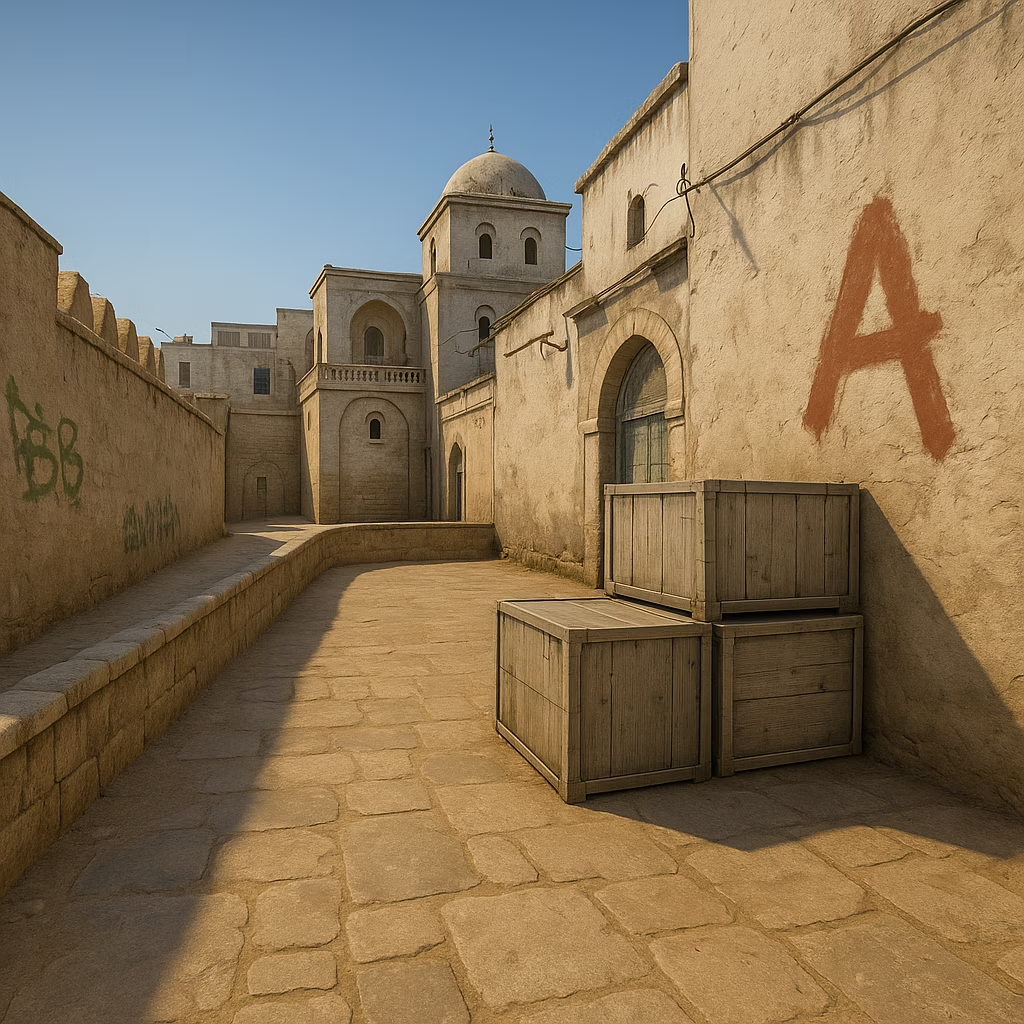
The theoretical became terrifyingly tangible on the storied lanes of Mirage. Here, G2 Esports' young phenom, m0NESY, demonstrated the bug's potent reality. In a sequence that would ripple through the tournament, he employed the classic terrorist-side window smoke, a tactical staple meant to blind. Yet, from his perspective, the fog parted just enough. Where his opponents saw only a uniform gray wall, m0NESY perceived shifting shadows, the outlines of adversaries believing themselves secure. With two swift, clinical shots, he transformed a defensive utility into a lethal advantage. The move was undeniably effective, yet it left a bitter aftertaste. The controversy was immediate, but m0NESY revealed a critical detail: his team had sought clarity from the tournament organizers themselves. The response from PGL was that they "allowed it to use." This official sanction, later reinforced by a tweet stating they were using the latest game client and would allow the smoke interaction moving forward, placed the burden of ethics not on the rulebook, but squarely on the shoulders of the players and teams.
A Pact Forged in Pixel: The Players' Collective Stance
Faced with a landscape where a technical flaw could decide the fate of a million-dollar major, the competitors did not retreat into isolated camps. Instead, they convened not on the server, but in council. Guided by the Counter-Strike Professional Players' Association (CSPPA), the collective undertook a formal vote. This was no gentleman's agreement whispered in green rooms; it was a structured, democratic rejection of the exploit. The consensus was resounding and unequivocal: the bug was game-breaking. FaZe Clan's stalwart, Twistzz, eloquently framed the danger, noting the bug's menace was not confined to Mirage's arches and apartments. It was a systemic fault, a crack that could spiderweb across every map in the active pool, turning any smoke into a potential liability. The players recognized that to embrace this flaw was to undermine the very essence of their competition—a contest of aim, teamwork, and strategy, not a scavenger hunt for rendering errors.
The Core Arguments Against the Bug:
-
❌ Integrity Erosion: It fundamentally broke the intended risk-reward balance of utility use.
-
❌ Unfair Advantage: Created non-reciprocal situations where one player could see through a smoke neither team could reliably reproduce.
-
❌ Strategic Corruption: Would incentivize players to seek out and memorize bug exploits over mastering genuine game mechanics.
-
❌ Viewer Distrust: Could make legitimate, skillful plays appear suspect to the watching audience.
Voices from the Veterans: Wisdom and Warning
The decision resonated with profound approval from the game's elder statesmen. Former Virtus.pro legend, TaZ, cut to the heart of the issue with seasoned clarity. "Makes no sense," he stated, viewing the organizer's initial permissiveness as a profound risk. "This can potentially harm the tournament," he warned, painting a dystopian picture of a future where professional practice rooms buzz not with strat calls, but with the systematic hunting of graphical glitches. He highlighted the inevitable pressure: in the high-stakes crucible of a major, there will always be a team or a player on the razor's edge of elimination for whom the temptation to cross an ethical line becomes overwhelming. TaZ asserted that the primary responsibility to "bring them back in line" must lie with the tournament itself, through clear, enforceable rules, not post-hoc player pacts. His words served as a reminder that the framework of competition must protect competitors from themselves and from the game's occasional imperfections.
The Developer's Decree and Lingering Echoes
As the debate reached its zenith, a resolution came from the source. Valve, the stewards of CS:GO, deployed a fix, consigning the notorious smoke bug to the digital archives of patched exploits. The immediate threat was neutralized, yet the philosophical tremor it triggered continued to reverberate. The Antwerp incident left behind a simmering debate far more complex than a simple software glitch. It forced a critical examination of the social contract within esports:
| Stakeholder | Stance During the Incident | Underlying Principle |
|---|---|---|
| Tournament Organizer (PGL) | Permissive; ruled it legal within the game client. | Adherence to the literal, unmodified state of the provided game build. |
| Players (via CSPPA) | Prohibitive; collectively voted to ban its use. | Preservation of competitive integrity and skill-based competition. |
| Veterans & Analysts | Critical of permissiveness; called for top-down rules. | Need for a consistent, enforceable ethical framework from authorities. |
This episode posed enduring questions: In the absence of a specific rule, is everything within the game's code fair game? Where does "game sense" end and "exploit abuse" begin? The players' collective action in Antwerp set a powerful precedent, a testament to a community's ability to self-regulate in defense of their sport's soul. However, it also highlighted a dangerous reliance on that very self-regulation. The poetic irony is lasting—in a game where vision and obscuration are paramount, the community was left seeking clarity on a moral landscape far more nebulous than any smoke grenade. The bug is gone, but the conversation about the shadows it cast on the nature of fair play remains, unresolved, in the competitive ether.
Comments