
Longtime Valve level designer Magnar Jenssen, known for his work on Counter-Strike's most iconic battlefields, recently ended an 18-month social media silence to deliver what can only be described as a gut-punch of a game development anecdote. As the Counter-Strike community continues to celebrate the refined, ray-traced beauty of Overpass in CS2, Jenssen offered a single, unforgettable glimpse behind the curtain: a humble kitchen pot served as the placeholder for an electrical junction box handle during the map's creation nearly a decade ago. The revelation, shared in a half-joking, half-deadpan tweet, reads like a knowing wink to every developer who has ever sacrificed a household item in the name of shipping a product.
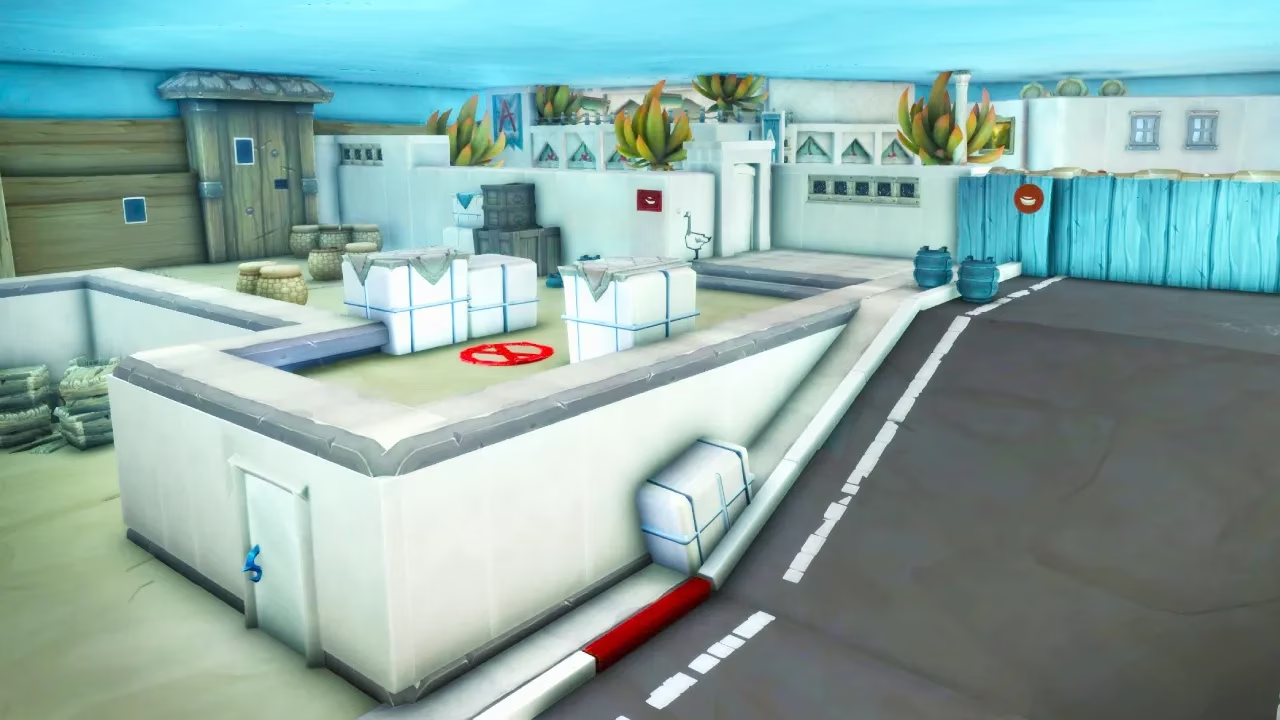
Jenssen, who joined Valve in 2013 after prestigious stints at Grin, Starbreeze, and Avalanche, walked into a development pressure cooker. That year's Winter Offensive update had just introduced Overpass and Cobblestone to CS:GO, two maps destined to become both beloved and reviled in equal measure. While Cobblestone eventually found competitive favor, Overpass demanded immediate, aggressive tuning. As a newcomer tasked with polishing the map’s details, Jenssen needed a quick, functional handle for a nondescript electrical fixture. Rather than pester senior artists or model a custom asset from scratch, he grabbed a digital pot from a common prop library and slapped it onto the geometry. It fit. It functioned. And so it stayed.
The beauty of this story lies not in grand technical wizardry but in its mundane genius. Imagine an orchestra performing a symphony with a rubber band holding the conductor’s baton together — it’s invisible to the audience, yet without it, chaos. That's the role of the pot in Overpass. For years, players sprinted past that junction box, chucked grenades near it, and pixel-hunted enemy heads beside it, completely oblivious that a piece of cookware was masquerading as industrial hardware. The asset was never a secret; it was simply too ordinary for anyone to question. It became a silent, soldier-level contributor to one of esports' most celebrated maps.
This kind of resourcefulness is the duct tape and string holding together even the shiniest virtual worlds. The technique mirrors what might be called a "recycled canvas" approach — painting a masterpiece over a thrift-store frame so skillfully that no gallery visitor suspects frugality. Fallout 3 famously featured a moving Metro train that was actually an NPC wearing a train model as an arm piece, a cheat so beloved it became legend. BioShock’s opening statue was a scaled-up bust of Andrew Ryan from the game’s climax, accidentally left oversized because someone forgot to remodel it. These are not bugs; they are scars of battle. They prove that game development, for all its polish, is an art form built on negotiation between ambition and deadline.
By 2026, with CS2 having matured into the definitive competitive shooter, Overpass stands as a testament to iterative evolution. The map’s CS2 rework glistens with improved lighting, retextured surfaces, and physics-driven clutter, but the underlying skeleton still bears marks of those early, frantic production days. The pot, presumably, has been replaced by a proper bespoke asset — or perhaps it still lingers, now elevated to eastern egg status by a development team with a sense of humor. Valve, notorious for its flat hierarchy and willingness to let good ideas come from anywhere, clearly fosters an environment where a junior designer can solve a problem with a cooking utensil and call it a day.
The anecdote also arrives at a time when the Counter-Strike economy is buzzing. Recent Steam marketplace updates have seen dust-covered skins suddenly sell for surprising sums, a phenomenon that adds a layer of real-world value to every pixelated crate and handle. If a virtual pot can fool millions into thinking it's a high-voltage switch, then the line between cosmetic rarity and functional utility already blurred long ago. Players may now inspect every corner of Overpass with renewed suspicion, wondering which other props lead double lives.
Ultimately, Jenssen's deep dive — which he closed with the words "this concludes the design deep dive" — serves as a reminder that video games are not monolithic sculptures carved from perfection. They are living, breathing collages of accidents, short-term fixes that became permanent, and quiet, brilliant improvisations. The pot on Overpass is a monument to creative thrift. And in an industry obsessed with graphical fidelity and cinematics, sometimes a kitchen implement is the most honest asset of all.
Comments