
It’s been a little while since Valve flipped the switch on what was billed as a “beta” update to the Steam Community Market – but let’s be real, it never really felt like a test. The overhaul rolled out to every single user, with an opt-out tucked away for the purists, and in the months since it’s quietly reshaped how millions of PC gamers trade virtual goodies. While the headline tech is the eye-watering 27 million unique images Valve generated just for Counter-Strike 2 listings, the real win is that the whole marketplace experience now feels, in a word, human.
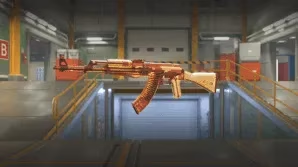
At the heart of the change is a fundamental rethink of how items live inside the market. Instead of peering at a tiny generic thumbnail and crossing your fingers, every listing now gets the full red carpet treatment. Think oversized images, deep-dive descriptions, and callouts that would make a data nerd weep with joy – wear values, float decimals, pattern templates, and even attached gadgets like charms and stickers now surface right there on the page. If you’ve ever tried to hunt down a specific phase of a knife or a particular sticker combo, you’ll know this is a game-changer. No more launching the game just to eyeball a pattern; the market finally does the heavy lifting.
One PC Gamer staffer, who is about as far from a skin mogul as you can get, had a rusty old M4A1-S Guardian skin in “Field Tested” condition gathering digital dust at $40 for years. He’d forgotten it even existed. Then, right around the time the new market went live, the sale notification pinged. Coincidence? Maybe. But when you can suddenly flip through item variants like pages in a catalogue and compare details without squinting, impulse buys become the order of the day. That same casual seller later discovered a neglected P90 skin in his inventory that was inexplicably worth $36, and listing it took all of ten seconds. The friction is gone, and that’s great news for anyone who’d rather frag than faff about with spreadsheets.

Valve didn’t just slap a fresh coat of paint on the thing, either. Quality-of-life tweaks are threaded through every corner: listings load automatically as you scroll, advanced search is now accessible from more page headers, and a proper breadcrumb trail means you won’t lose your place while digging through hundreds of pages. Long lists finally support text entry, so you can jump straight to the item you want instead of playing the endless scroll game. It’s the kind of polish that makes you wonder how we coped for so long with the old clunky interface.
Counter-Strike 2 was the obvious guinea pig – its item economy is by far the most rabid on the platform – and Valve leaned in hard. They built a pipeline that renders every single in-game object as a unique image for the market listing, meaning the AWP Dragon Lore you’re eyeing up shows exactly what you’ll get, not some idealized studio shot. To pull that off, the team generated over 27 million unique images retroactively for existing CS2 listings, a number that still boggles the mind. But the real kicker is that the tech isn’t locked to CS2. Valve has said the integration will work across all games with tradeable items, and that covers a startling volume of titles.
That scale is worth a double-take. There are more than 13,000 games on Steam with tradeable items, and over 700 that feature in-game goods (the gap is mostly filled by stickers and other collectible fluff). The market overhaul was stress-tested on CS2, but the infrastructure now exists for everything from Dota 2 arcanas to Team Fortress 2 hats to finally get the same thoughtful treatment. Valve has been characteristically quiet about rollout timelines – they move at Valve Time, after all – but the fact that the underlying system is already live across the platform suggests it’s only a matter of time before you’re browsing detailed Rust skin previews without firing up the game.
What does this mean for the average Joe who just wants to trade a duplicate card or offload a mid-tier skin? A lot, actually. The market has always been functional in a “it technically works” sort of way, but it was also full of nooks and crannies where vital information hid. Now, similar items are intelligently grouped on a single page, and you can flip between variants with tabs and real-time previews. The filtering system has also grown a brain, surfacing unique properties – float values for CS2, unusual effects for Dota 2 couriers – in a way that feels intuitive rather than like deciphering an Excel sheet.
The bottom line? If you’ve been sitting on virtual gold without even knowing it, this update might just be the nudge that turns forgotten inventory clutter into wallet funds. And even if you’re not a trader, simply browsing the market is no longer a chore – it’s verging on enjoyable. The old guard might miss the jank, but for the rest of us, this is a textbook no-brainer. With over 27 million unique images already baked in and a foundation that reaches across thousands of titles, Valve has turned the Steam Community Market from a grungy bazaar into something that finally feels like it belongs in 2026.
Comments